In finance and accounting, reconciliation is the process that keeps financial records accurate, complete, and reliable. Among its many forms, vendor reconciliation plays a vital role in ensuring that an organization’s accounts payable records match those of its suppliers.
Imagine a vendor following up on an invoice they believe is still unpaid. Your ERP shows the payment was made months ago. The vendor shares a statement containing debit notes, credit notes, and other adjustments that don’t exist in your ledger. What initially appeared to be a simple query quickly becomes a time-consuming investigation involving multiple teams and supporting documents.
This is exactly why vendor reconciliation has become a critical finance process. As businesses process thousands of invoices, payments, credit notes, and adjustments every month, differences between vendor statements and internal books become inevitable. Without a structured reconciliation process, these discrepancies can remain undetected for months, resulting in supplier disputes, delayed payments, inaccurate financial reporting, duplicate payments, and unnecessary financial risk. Despite its importance, vendor reconciliation remains one of the most under-automated processes within the accounts payable function.
What Is Vendor Reconciliation?
Vendor ledger reconciliation is the process of matching vendor statements / vendor ledgers with internal records to ensure that all transactions are accurately recorded and outstanding balances are correctly reflected in both sets of books. When performed regularly, vendor reconciliation helps organizations detect errors, prevent duplicate payments, recover missing credits, and maintain accurate financial records.
Vendor Reconciliation vs Accounts Payable Reconciliation
These terms are often confused but serve different purposes.
| Area | Vendor Reconciliation | Accounts Payable (AP) Reconciliation |
| Comparison | Vendor Statement vs Internal Ledger | AP Subledger vs General Ledger |
| Objective | Validate balances with suppliers / vendors | Validate accounting records |
| Participants | Vendor, Procurement, AP Team | Finance Team |
| Focus | Transaction Accuracy | Financial Statement Accuracy |
| Outcome | Supplier Agreement | Ledger Integrity |
Accounts Payable reconciliation confirms that internal books are correct. Vendor reconciliation confirms that both parties agree. Both controls are essential. Because both controls work together, many finance teams manage customer and vendor reconciliation as a single, streamlined process.
Why Vendor Reconciliation Matters ?
Vendor reconciliation is not merely an accounting exercise.
It directly impacts:
- Financial reporting
- Working capital
- Internal Control & Compliance
- Cash flow
- Vendor relationships
- Audit readiness
Let’s examine the business impact.
1. Improves Financial Reporting Accuracy
Unreconciled vendor balances can result in:
- Understated liabilities
- Overstated liabilities
- Incorrect accruals
- Misstated expenses
This directly impacts management reporting and statutory financial statements.
2. Recovers Unclaimed Vendor Credits
Many organisations lose money because vendor credit notes are never recorded.
Common examples include:
- Purchase returns
- Rate differences
- Damaged goods
- Commercial settlements
- Annual rebates
Without reconciliation, these credits often remain undiscovered.
3. Strengthens Internal Controls
Vendor reconciliation serves as a powerful detective control against:
- Duplicate payments
- Unauthorized adjustments
- Vendor fraud
- Incorrect postings
- Process failures
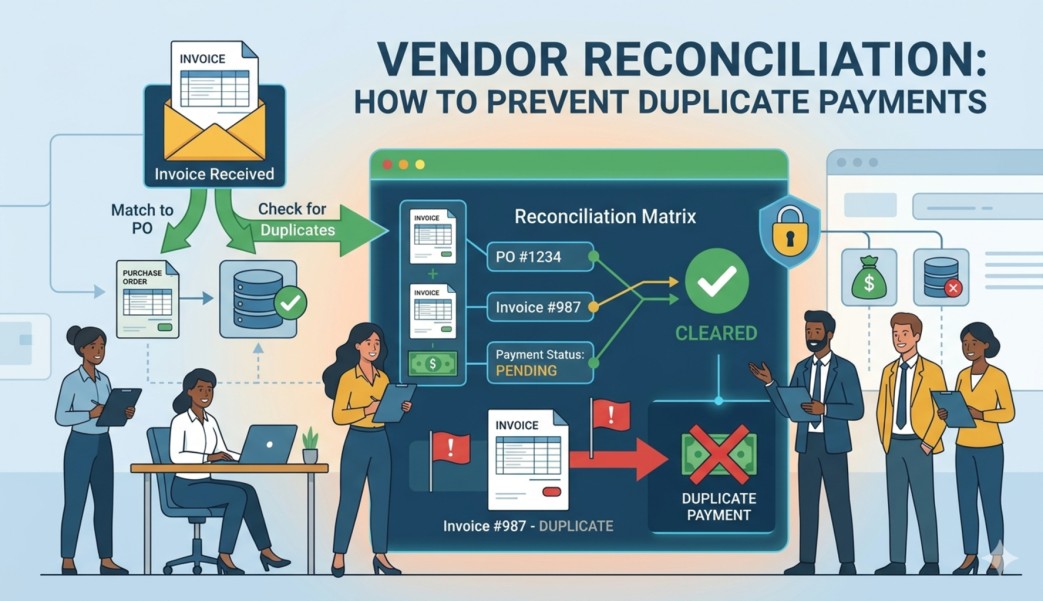
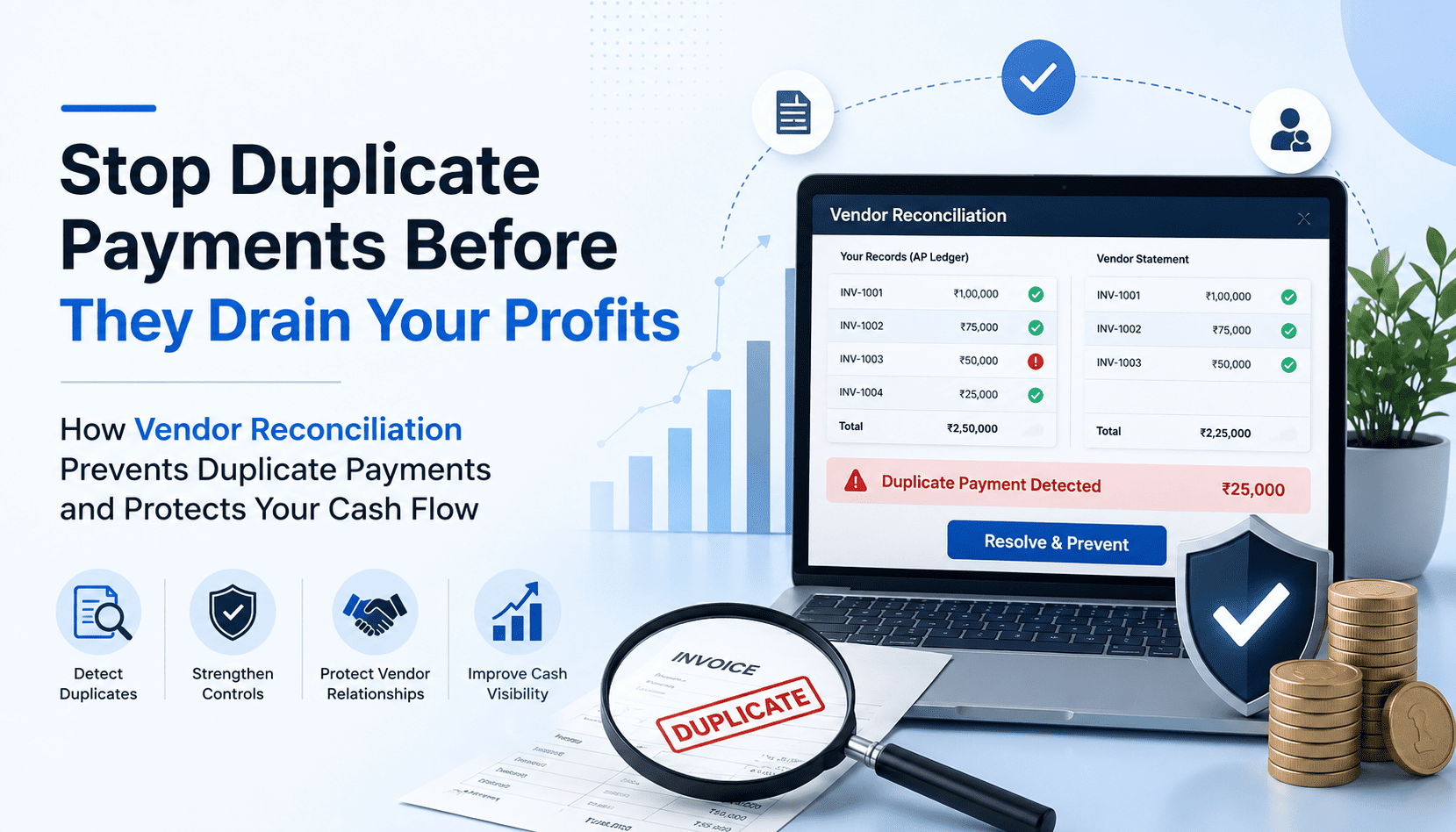
4. Prevents Duplicate Payments
Duplicate payments remain one of the most common sources of financial leakage. Causes include:
- Duplicate invoice submission
- Manual processing errors
- Multiple invoice formats
- ERP integration issues
Regular reconciliation helps identify duplicate payments before they become permanent losses.
For a deeper look, see our guide on how vendor reconciliation prevents duplicate payments.
5. Improves Vendor Relationships
Suppliers value customers who maintain accurate records and resolve disputes promptly.
Benefits includes:
- Faster dispute resolutions
- Improved supplier confidence
- Better commercial negotiations
- Early payment discounts
- Extended credit periods
Why Vendor Reconciliation Fails: Common Challenges Faced by Finance Teams ?
Despite being a critical financial control, vendor reconciliation remains one of the most time-consuming and error-prone activities within the accounts payable function. As organizations grow, transaction volumes increase, data becomes fragmented across multiple systems, and manual processes struggle to keep pace.
Below are the most common reasons why vendor reconciliation fails.
1. High Transaction Volumes
Large organizations process thousands of invoices, payments, debit notes, and credit notes every month. Reconciling these transactions manually within the monthly / quarterly close timeline is often unrealistic. As volumes grow, finance teams spend more time matching records than investigating genuine exceptions.
2. Data Spread Across Multiple ERP Systems and Formats
Vendor statements rarely arrive in a standard format. They may be generated from SAP, Oracle, Microsoft Dynamics, Tally, Zoho, Navision, or other ERP systems, while your organization’s ledger resides in a different ERP altogether.
On top of that, vendors share statements in Excel, PDF, scanned images, or even email text. Before reconciliation can begin, finance teams often spend hours cleaning, standardizing, and mapping data received from vendors.
3. Low Vendor Response Rates
Successful reconciliation depends on receiving timely and accurate vendor statements. However, many organizations receive statements from 10-30% of their vendors. Non Response, delayed responses, incomplete statements, and inconsistent follow-ups prolong the reconciliation cycle and leave balances unresolved.
4. Data Inconsistencies and Missing References
Even when both the organization and the vendor record the same transaction, differences in invoice numbers, payment references, debit note references, credit note references, or amounts (such as those arising from TDS deductions) can prevent transactions from matching automatically. As a result, reconciliation teams spend significant time manually identifying, validating, and resolving these exceptions instead of focusing on genuine discrepancies.
5. Process Dependency and Manual Effort
In many organizations, vendor reconciliation depends heavily on individual team members and spreadsheet-based processes. Knowledge remains with a few experienced employees, making the process difficult to scale, standardize, or audit. This dependency also increases the risk of errors when team members are unavailable or workloads increase.
How Firmway Automates Vendor Reconciliation
Manual vendor reconciliation involves much more than matching transactions. Finance teams spend considerable time requesting vendor statements, following up with vendors, preparing ledger data, reconciling transactions, investigating exceptions, and managing reviews and approvals. As transaction volumes increase, these manual activities slow down the financial close process and increase the risk of errors.
Firmway automates the entire vendor reconciliation lifecycle. From seamlessly integrating with your ERP and collecting vendor statements through automated email and SMS requests, to AI-powered ledger reading, intelligent transaction matching, exception management, workflow approvals, and digital sign-offs, every stage of the reconciliation process is streamlined within a single platform.
Unlike traditional reconciliation tools that rely on exact data matches, Firmway intelligently identifies matching transactions even when there are differences in invoice numbers, payment references, debit or credit note references, or TDS-related amount variations. The platform also provides real-time dashboards to track vendor responses, reconciliation progress, pending actions, and overall process completion, giving finance teams complete visibility throughout the reconciliation lifecycle.
The result is a faster, more accurate, and fully auditable reconciliation process. Instead of spending valuable time collecting statements, preparing data, and manually matching transactions, finance teams can focus on reviewing genuine exceptions, strengthening vendor relationships, and accelerating the month-end close.
Ready to modernize your vendor reconciliation process? Schedule a personalized demo to see how Firmway helps organizations automate reconciliation from statement collection to final sign-off. See how Firmway can streamline your vendor reconciliation
 How Vendor Reconciliation Supports Duplicate Payment Prevention