
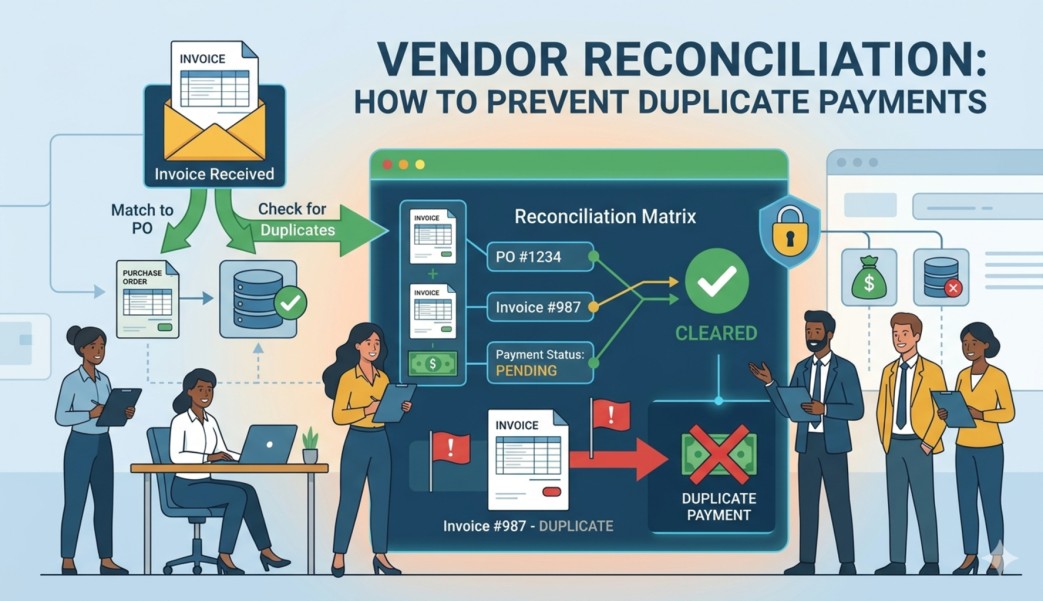
Duplicate Payment Prevention is one of the biggest priorities for modern finance teams. Vendor Reconciliation plays a critical role in preventing duplicate payments before they impact cash flow. Without a solid Vendor Reconciliation process, duplicate payments quietly drain your budget, damage supplier relationships, and create serious compliance headaches. In this guide, you’ll learn exactly how Vendor Reconciliation works, why duplicate payments happen, and the practical steps your team can take for Duplicate Payment Prevention.
The Hidden Cost of Skipping Vendor Reconciliation :
Most finance leaders believe their accounts payable process is airtight. Internal controls are in place. The ERP is configured. The team is experienced. Duplicate payments? “That doesn’t happen here.”
But it does — and more often than most organizations realize.
According to the Institute of Finance and Management (IOFM), 0.1% to 0.5% of all B2B payments are duplicates. For a company processing ₹100 crore in vendor payments annually, that translates to ₹10 to ₹50 lakhs paid out twice — often sitting silently in a vendor’s books, never voluntarily returned.
Vendor reconciliation is the single most effective control to catch these leakages before they compound. Yet, most teams treat it as a back-office arithmetic exercise rather than the cash-protection mechanism it truly is.
Why Duplicate Payments Still Happen Despite Strong Controls
Finance teams often resist the idea that duplicates could be slipping through. Here are the real-world reasons they do, with examples that will feel familiar.
- Invoice Number Formatting Inconsistencies
This is perhaps the most common and least visible cause. A vendor submits invoice 2300001. Your team books it correctly. The same invoice arrives again this time with the vendor’s reference formatted as 0001 (as printed on a physical copy or retyped by a different person). The system does not flag it as a duplicate because the invoice numbers do not match exactly.
Result: both entries are processed and paid.
- Paper and Email Channels Running in Parallel
Many vendors send invoices both by email and by post. If your AP team processes email invoices and the physical copy lands with a different person, the same liability gets recorded twice often in different periods or under slightly different vendor names.
- Manual Data Entry Errors
A ₹1,23,456 invoice keyed as ₹12,34,56 gets rejected during validation. The team re-enters it correctly this time but the original, erroneous entry was already processed for payment before the error was caught. Two payments exit.
- Vendor Name Variations in the Master Data
“Tata Consultancy Services,” “TCS,” and “TCS Ltd.” may all exist in your vendor master as separate records. Payments against the same underlying vendor and the same invoice can go through on different records without triggering a duplicate alert.
- Credit Note Not Applied Before Payment
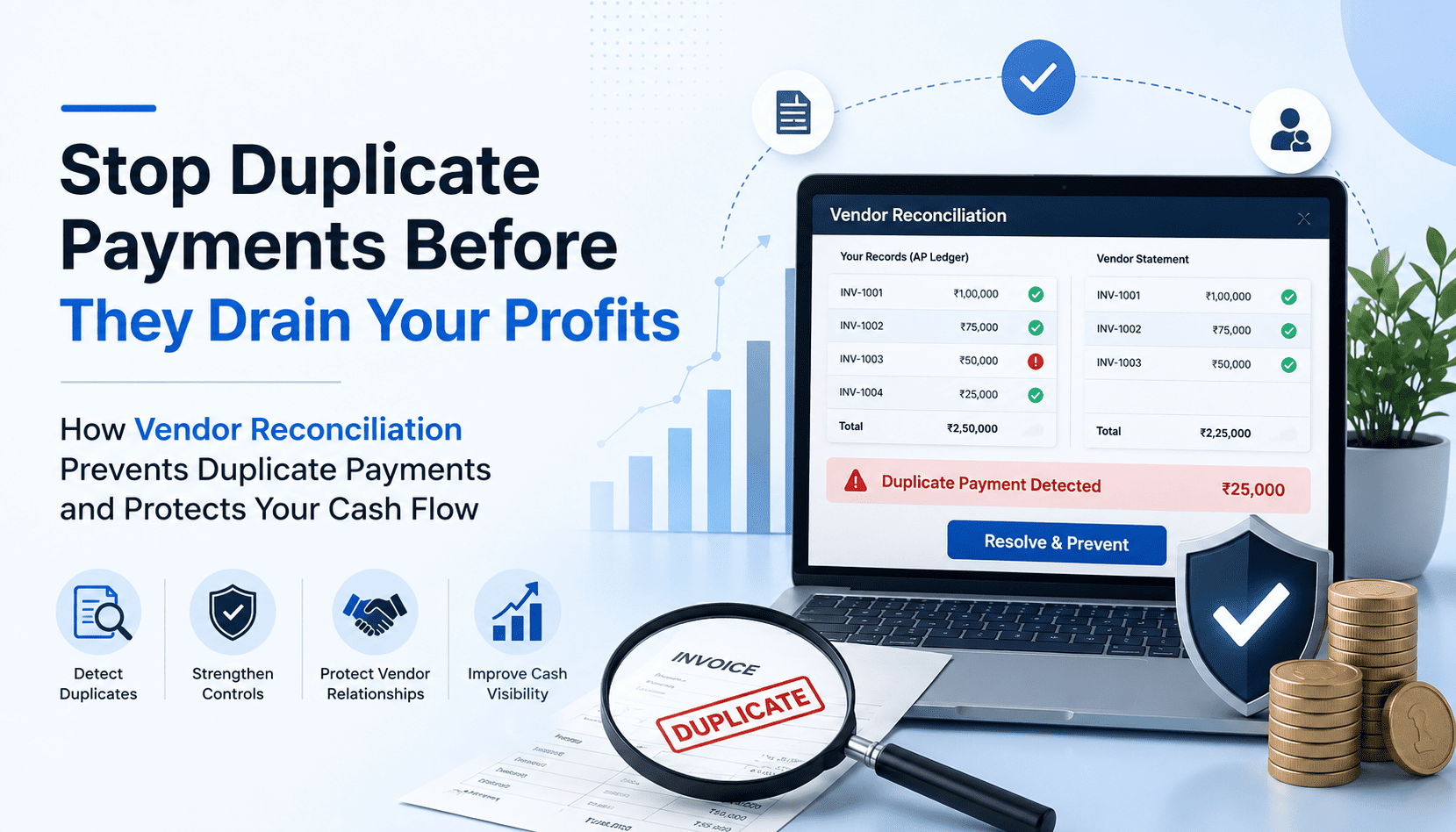
A vendor issues a credit note for ₹25,000 against a disputed delivery. The credit is recorded in your books, but when the next invoice arrives, the AP team processes the full amount without netting the credit. You have overpaid by ₹25,000 not a classic duplicate, but equally a cash leakage that reconciliation is designed to catch.
- System Migrations and Cut-Overs
During an ERP upgrade or entity merger, historical transactions are migrated. Some invoices already paid in the old system get flagged as “open” in the new one and are processed again in the first payment run.
 How Vendor Reconciliation Supports Duplicate Payment Prevention
 How Vendor Reconciliation Supports Duplicate Payment Prevention
Vendor reconciliation specifically, matching your AP ledger against the vendor’s statement creates an independent verification layer that your internal controls alone cannot provide.
- On invoice number mismatches:
When you reconcile against the vendor’s statement, the same transaction appears once on their side. So if your books show two payments for what the vendor records as one invoice, the mismatch becomes immediately visible regardless of how differently the invoice number was formatted at the time of booking.
- On parallel channel duplicates:
A vendor’s statement reflects what they’ve billed you, not how many times your team received it. As a result, reconciliation collapses both entries into a single verifiable transaction.
- On vendor master fragmentation:
Reconciliation happens vendor by vendor. Even if “TCS” and “TCS Ltd.” exist as separate master records, the exercise forces your team to engage with the actual vendor and consolidate the full picture of your liability to them.
- On unapplied credit notes:
The vendor’s statement will show the credit note as an offset. Therefore, if your ledger doesn’t reflect it, the gap surfaces during reconciliation before the next payment run.
- On post-migration open items:
A reconciliation performed soon after go-live will immediately expose transactions the vendor considers closed but your new system still shows as payable.
In each case, the logic is the same: your internal records and the vendor’s records cannot both be right. Reconciliation forces that confrontation and the earlier it happens, the less cash has already left your account.
Conclusion: Duplicate Payment Prevention Requires Smarter Vendor Reconciliation
Duplicate Payment Prevention isn’t just about avoiding accounting errors—it’s about protecting your cash flow, vendor relationships, and financial credibility. Moreover, when done consistently, vendor reconciliation is your most reliable line of defense.
But manual reconciliation is time-consuming and error-prone. And as your vendor base grows, the cracks only widen. So the question is no longer whether you need a robust vendor reconciliation process it’s how quickly you can put one in place.
That’s where Firmway comes in. Firmway’s automated vendor reconciliation software detects duplicate payments before they go through, matches invoices and payment records at scale, and gives your finance team real-time visibility into every vendor account without the spreadsheet chaos.
Stop overpaying. Start reconciling smarter.