
Balance & Audit Confirmations

Balance & Audit Confirmations: What You Need to Know About

All About Digitized Balance & Audit Confirmations

A balance & audit confirmations letter is a crucial request sent to third parties in order to gather specific information regarding items that significantly impact the financial statement. Consequently, this process plays a pivotal role, as it aids in substantiating various assertions made in the financial statement, ultimately contributing to the formation of a well-informed opinion about its accuracy.

Importance of External Confirmation in Auditing

In the field of auditing, external confirmation, especially for financial elements like banks, loans, payables, receivables, and more, is a widely practiced method. To secure compliance and standardize the confirmation process, the Auditing and Assurance Standards Board (AASB) empowered by the Institute of Chartered Accountants of India (ICAI) issued SA 505: External confirmations. Further, to assist the professional accountants in implementing the confirmation process, ICAI issued the guidance notes that provide for obtaining confirmations for receivables, cash and bank balance, and liabilities.

Automating the Balance & Audit Confirmation Process

Conventionally, auditors use letters, posts, or emails to obtain confirmations from external parties. Click here for manual balance confirmation samples – negative or positive. However, it is not a sustainable solution for a high volume of accounts of large-scale businesses. Thus, there is a need for digital transformation. In this article, we will delve into the concept of digital balance confirmation letters. Additionally, digital transformation plays a crucial role in assisting auditors in automating tedious parts of audits. Furthermore, in the context of external confirmation, automation will not only lower clerical errors but also significantly enhance the efficacy of the audit evidence.

Streamlining Balance & Audit Confirmations with Firmway

An affordable way to automate the external confirmation process involves the adoption of software such as Firmway. Furthermore, Firmway stands as India’s premier online software for balance confirmations. Leveraging cutting-edge technology, it streamlines and standardizes the process of obtaining external confirmations.

Effortless Responses

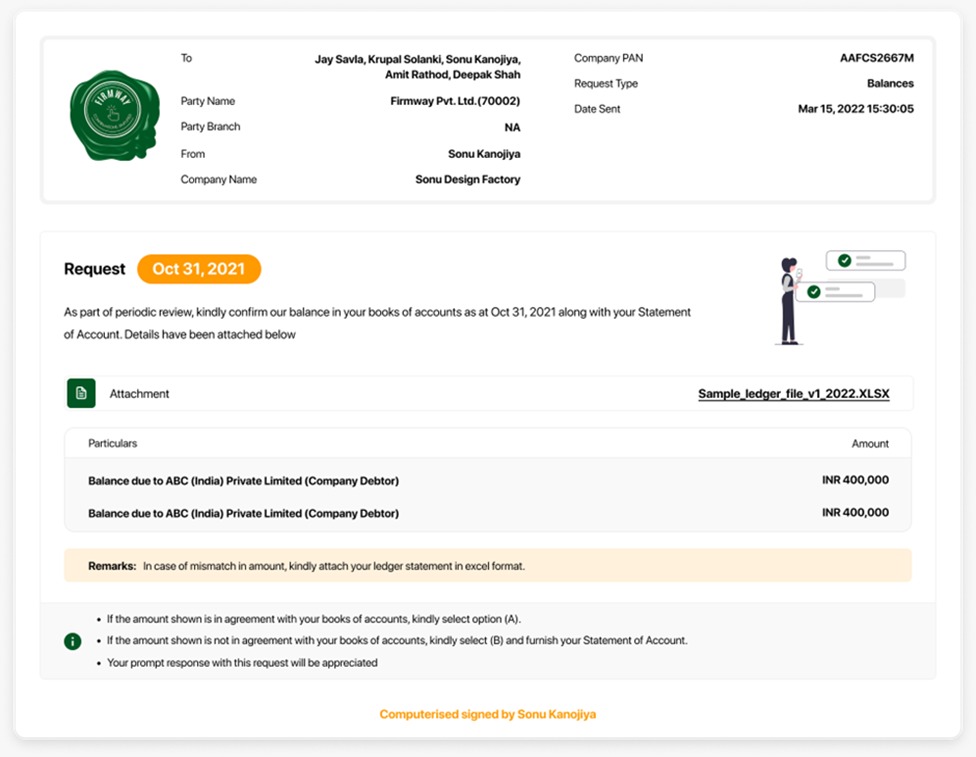
It allows auditors to efficiently process bulk requests and provides a comprehensive synopsis of reconciled and unreconciled balances. It allows debtors/creditors/banks to respond easily in the following ways:

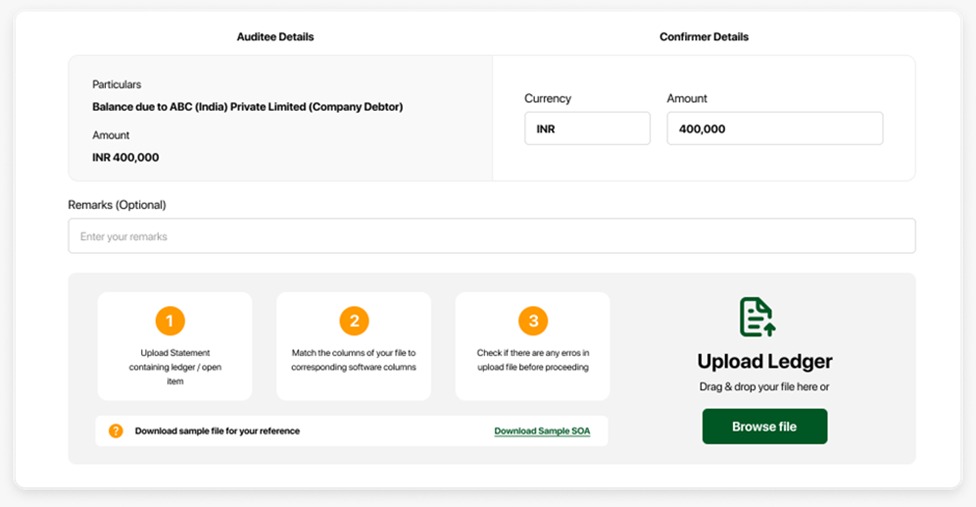
1: Click on the unique link to respond & will be directed towards response sheet

2: Click on “amount is correct / incorrect” as per your deal (Only valid for positive & negative confirmation)

3: Incase of blank confirmation ask responding party to add the amount as per their books

4: Responses confirmed with auto-generated OTP verification shared on third party email id

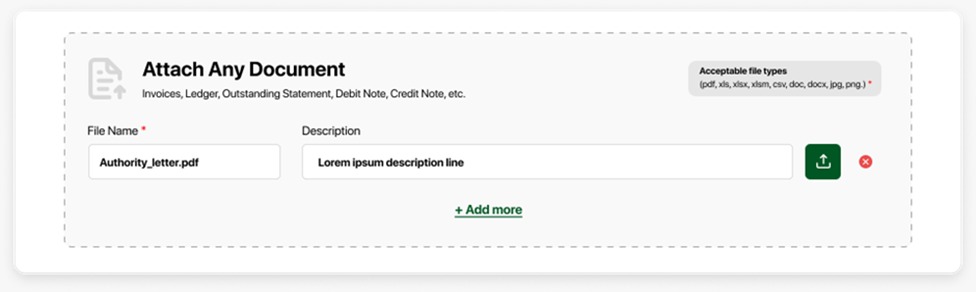
5: Live Tracking of responses on dashboard for audit trail purpose
 

Balance & Audit Confirmations

Balance & Audit Confirmation

Balance & Audit Confirmations

Balance & Audit Confirmations

Balance & Audit Confirmations

Leveraging Audit Automation Tools

In this way, audit automation tools make confirmation easier for third parties and resolve the issue of manual follow-ups, fewer responses, tracking the data, collecting & accumulating the data. All leading accounting and auditing firms are automating the labor-intensive part of the audit to focus on analytical work. Thus, it is high time to leverage technology to smoothen the audit process.
Understanding Sec 194Q

Understanding Sec 194Q: How it impacts And Why It’s Important

Background

Business returns constitute less than 2% of overall Income Tax Returns filed in India for AY 2021-22, underscoring the pressing need for Step-by-Step Understanding  Sec 194Q. Furthermore, clearly indicating evasion of taxes. To combat tax evasions and non-filing of returns, the Indian government has expanded TDS and TCS provisions in the past two years.

The government is working towards bringing dividends, purchases, sales, e-commerce operators, etc., all under the scope of TDS and TCS as it makes tracking transactions easier. Specifically, the TDS/TCS provisions on purchases and sales are redefining steps for India’s taxation system.

Understanding Sec 194Q: Gaining Proficiency in Step-by-Step Mastery of Section 194Q and Understanding Its Impact

Section 194Q, introduced under the Finance Act, 2021, effective from 1st July 2021, aims to curb tax evasions and fraud. Additionally, it mandates that buyers with turnovers exceeding Rs 10 crores in the preceding financial year deduct tax on purchases over Rs 50 lakhs, given the seller’s Indian residency.

Moreover, with 194Q in effect, all high-volume sale/purchase transactions will come under record, thereby significantly reducing the chances of evasions. However, these provisions inevitably add to the concerns of the CFOs and tax heads of large-scale companies in terms of its implementation and reporting.

Challenges faced by large-scale companies are:

Since large-scale companies have a high volume of sales and purchases both, availing of accurate TDS credits as well as deducting vendor TDS get wearisome for tax and finance teams.

Year-on-year locking of tax credits is a common problem among large-scale enterprises. Errors in availing of TDS credits and deducting TDS affect working capital efficiencies and invite tax scrutiny.

The process of maintaining vendor records, obtaining low tax deduction certificates, tracking vendor payments, availing TDS/TCS credits, reconciling 26 AS, etc., is voluminous and time-consuming, especially when done manually.

Thus, finance and direct tax teams should find the automation and technology-enabled solutions. 

Understanding Sec 194Q

Understanding Sec 194Q: Streamlining Compliance through Step-by-Step Automation

Technology and automation make it easier to handle TDS/TCS deductions, availing credits, and reconciling Section 194Q step by step. To ensure complete TDS and TCS credits, it’s vital to reconcile 26 AS regularly and maintain accurate accounts. Instead of waiting until year-end, companies should aim to reconcile 26AS quarterly to avoid credit losses. Businesses have to try to complete this reconciliation every three months.

Automation enables companies to incorporate reconciliation into their regular assessments. This, in turn, helps in proactive communication with vendors and reduces the risk of working capital shortages and credit losses.

Firmway is one such software that assists with 26 AS reconciliations. It is a web-based SaaS product that automates time-consuming reconciliations. Many big firms in India rely on it to simplify the reconciliation procedure for massive 26 AS entries and books of accounts. It includes a PAN-TAN connection, automated reconciliation, and communication of differences. As a result, it simplifies the implementation of new tax regulations, such as 194Q.

Conclusion

The Indian government is taking steps to make the country more tax-compliant, and large businesses should assist. Businesses can quickly comply with new tax requirements thanks to technology. Automation helps highlight unresolved issues regarding 26 AS reconciliations and gives CFOs data-driven insights. Therefore, businesses should use automated technology and software to help create a tax-compliant economy.

Data Digging

Data Digging in Accounting: Insights for Improved Cash Flow

Transforming Accounting: From Data Digging to Enhancing Cash Flow

Accounting has traditionally played the role of the data keeper. However, recent developments have expanded the roles of account teams, changing this perception from mere data recording to actively enhancing cash flow. Businesses have regarded the accounting team as both a booster of cash flow and a cost center, with their main function being the maintenance of records of company activities. The 21st Century has realized the importance of data and its analysis. Moreover, data analysis is not just limited to operational activities; it has also made its presence felt in the accounting function. One such Data Digging exercise we will be focusing on today is boosting cash flow through ledger reconciliation.

The Impact of Ledger Reconciliation on Cash Flow

Our experience with clients has led to the following observations from ledger reconciliation activities:

  • We identified Rs 998 crore in vendor-unadjusted advances.
  • The company raised a Rs 3,761 crore debit note that vendors or customers did not book.
  • Vendors reversed a Rs 2,942 crore invoice, even though the company had claimed GST credit.
  • Vendors issued Rs 314 crore in credit notes that the company did not account for.
  • Customers deducted Rs 53 crore in TDS, which the company failed to record.

All the above can have a direct and/or indirect impact on the cash flow of the Company. If the account team is able to identify such a mismatch on a timely basis and deep dive into it, then it can convert itself from a cost center to a profit center.

Data Digging for Cash Flow Enhancement

Manual reconciliations, even with Excel – MATCH, HIGHLIGHT, or LOOKUP formulas, bear the risk of human errors. Any inefficiency or deficiency in reconciliation plagues the entire enterprise; it affects the credibility of financials, causes inefficient decision-making, and affects the goodwill of a company. Automated reconciliation is the solution to all the above issues.

Data Digging

The Power of Automated Reconciliation

Automation can simplify and streamline the tedious reconciliations process. With minimal human involvement, the entire process of vendor communication, follow-ups, tracking, gathering, and summarizing voluminous information works automatically in the background. The added leverage of real-time analytics makes companies proactive and efficient. 

Enhancing Data Digging with Technology

Using technology for reconciliation has led to the observations shared above. Thus, CFOs and account teams should continue to adopt technologies that allow them to analyze and interpret the vast amount of data at their disposal.

The Role of Technology in Accounting

A team of chartered accountants started Firmway, a cloud-based automation software, to simplify time-consuming reconciliations. Using the latest technology, such as AI, it performs reconciliations on par with industry standards and practices.

Technology makes reconciliations, be it vendor, bank, GST, or TDS, simple and efficient. It also simplifies the communication of reconciliation differences through a world-class online action tracker. Thus, adopting technology in accounting and reconciliations should be a priority for CFOs and account teams.

GSTR-2B Reconciliation: Protecting Your Bottom Line with ITC

GSTR-2B Reconciliation: Protecting Your Bottom Line with ITC

Background

In recent years, fraudulent practices have been prevalent in availing Input Tax Credit (ITC). In FY2021, more than Rs 35,000 crores of ITC was wrongly claimed. This misuse primarily stemmed from Rule 36 of the CGST Rules, 2017. This underscores the critical importance of GSTR-2B reconciliation.

Rule 36 amendment and its impact

The amendment introduces GSTR-2B as a benchmark for determining the amount of eligible ITC. From January 2022, businesses can avail of ITC only to the extent reflected in GSTR-2B. Earlier, Rule 36 allowed buyers to avail of provisional ITC (over and above the amount prevailing in GSTR-2B) up to 5% of the eligible ITC reflected in GSTR-2B, but not anymore. Restricting ITC to GSTR-2B impacts businesses negatively, especially large-scale companies with crores of ITC in the funnel. Thus, it has become increasingly vital to reconcile GSTR-2B and the purchase register.

GSTR-2B Reconciliation

The Importance of GSTR-2B Reconciliation

Imagine losing crores of ITC due to inefficient reconciliation of GSTR-2B and purchase register. It will impact working capital and may even lead to a financial crisis. According to Ernst & Young, industry trends depicting mismanagement of ITC may increase working capital requirements by 5–7% and negatively impact profit before tax by 1–2%.

The following illustrations explain how inefficient GSTR-2B Reconciliation and purchase register may lead to the loss of ITC:

  1. Say out of Rs 1,00,000/- of total purchases, the supplier furnishes details of Rs 70,000/- in GSTR-1. Therefore, GSTR-2B will depict eligible ITC as Rs 70,000/-, and ITC worth Rs 30,000/- will be lost until the supplier updates it.
  2. A failure to update purchase-related credit notes in GSTR-2B can also result in overclaiming ITC, which is subject to penalties. CGST law prohibits ITC claims for credit notes, even if they are not yet updated in GSTR-2B.

Thus, the onus of reconciling GSTR-2B and the purchase register to reduce the risk of ITC disallowance and penalties is more prevalent than ever.

Why automate GSTR-2B Reconciliation? 

Reconciliation of innumerable transactions in GSTR-2B and the purchase register is a tedious task, especially when done manually. Reconciliation is possible with Excel formulas like Lookup, Match, etc., but to some extent only. There is always a risk of corrupting Excel files with heavy GSTR reports and purchase registers. Moreover, manual intervention in applying formulas also exposes you to errors, thus marking the need for automation in reconciliation.
According to Deloitte’s GST@5 survey 2022, reconciling ITC with auto-generated reports (GSTR-2B) is the highest-ranked issue with GST, and automation is an ideal solution. Adopting technology and automation for GST is prevailing in all large, medium, and small-scale enterprises, as they are losing crores of funds in ITC mismanagement.

One such software that can help you save crores is Firmway. It is a SaaS-based software company specializing in multi-GSTIN and multi-month reconciliation of GSTR-2B and purchase registers. This innovative platform automatically carries unmatched items from the previous month and matches them with the data from the following months. Achieving up to 95% accuracy, it relies on a unique blend of technology and algorithms. Not only reconciliation, but technology also smooths the next steps: vendor communication and summarizing reports. Thus, opt for technology to simplify the voluminous task of ITC reconciliations and save yourself from litigation.

External Confirmations In Audits: Best Practices For Success

External Confirmation In Audit: Best Practices For Success

Consequences of Non-Compliance with SAs

Members of The Institute of Chartered Accountants of India (ICAI) must conduct financial audits following Standards on Auditing (SAs) when fulfilling their attestation function. These standards include procedures for external confirmations. These standards represent widely accepted audit procedures. Deviation from SAs, especially in matters related to external confirmations, necessitates a formal declaration by the member. Failure to do so may lead to disciplinary proceedings under The Chartered Accountants Act, 1949. One such standard is SA 505: External Confirmations. It discusses the use of external confirmations and procedures to obtain direct evidence from third parties as required in SA 330: The Auditor’s Responses to Assessed Risks and SA 500: Audit Evidence.  External Confirmation In Audit is necessary to provide a true and fair view of a company’s financials. It serves as an extremely crucial piece of the puzzle when determining whether such financials are free from material misstatements or not.

External Confirmation :-

External Confirmations is a substantive procedure used to obtain audit evidence as a direct written response from a third party (customer/ vendor/bank) to the auditor in a paper, electronic or any other form.  Generally, auditors use it to determine account balances, status, or terms of agreements. There are primarily three types of confirmation requests:

1. Positive Confirmation Request:

It requires the confirming party to directly respond to the auditor whether it agrees or disagrees with the information provided in the request. Positive confirmations provide reliable audit evidence.

2. Negative Confirmation Request:

It asks the confirming party to respond directly to the auditor only if the confirming party disagrees with the information provided in the request. They provide less persuasive audit evidence than positive confirmations.

3. Blank Confirmation Request:

It is a type of positive confirmation request where the third party (confirming party) is asked to fill in the amount or provide certain information. It provides persuasive audit evidence since the confirming party must verify the information before responding.

External Confirmation In AuditWhy External Confirmation In Audit is needed?
For instance, in Mahavir Jain vs. Disciplinary Committee (Appellate Authority), the auditor formed his opinion without obtaining and examining external confirmations of all bank balances as required by SA 505. Consequently, the Chartered Accountant Act of 1949 held him guilty under Part 1 of the Second Schedule. This was due to his failure to exercise the due diligence expected of him and not obtaining sufficient information to form an opinion.

Further, SA 505 is the 3rd most non-compliant standard as per Quality Review Board in Financial Year (FY) 2020-21.

Process of external confirmations

As we know, obtaining confirmations manually via letters or even e-mails is a cumbersome procedure. One needs to maintain records and follow up continuously. External confirmations involve repetition of the following steps for every audit:

  1. Determine the information to be confirmed;
  2. Choose the appropriate parties;
  3. Design the confirmation requests, properly addressed with a request to send responses directly to the auditor;
  4.  Send and follow-up requests.

To simplify and streamline this process, major firms are adopting automated confirmation procedures. This enables audit teams to concentrate on analyzing results and identifying exceptions rather than investing time in evidence collection.

A team of Chartered Accountants started Firmway, a web-based SaaS software company, to help auditors automate the confirmation process in compliance with auditing standards. They digitized the entire confirmation process. Auditors benefit from automating the time-consuming external confirmation process in the following way:

  • Save 90 % man-days by automating the process of sending, receiving, and tracking confirmations using our portal
  • Complete audit documentation as highlighted in peer review process 
  • Increase response rate by 2x
  • Send 1000+ confirmation requests in compliance with standards on auditing
Auto Reconciliation

AI and ML Unlocking New Potential in Auto Reconciliations

Transform Auto Reconciliation with Breakthrough AI and ML

In this digital age, forward-looking organizations are adopting cutting-edge technologies, such as Artificial Intelligence (AI) and Machine Learning (ML), on a continuous basis. AI and ML and other technologies, including Auto Reconciliation, are not just trends; they are driving transformative changes. According to Mckinsey’s The State of AI in 2021 report, 56% of businesses are actively working to incorporate AI into various business functions, including finance, operations, marketing, and others.

AI and ML

Understanding of AI and ML

As AI and ML are in their infancy stages, people often confuse them as being the same. AI is a technology that uses math and logic to simulate computers to mimic human behavior. In contrast, ML is the application of AI through mathematical models to enable continuous learning and improvement in computers. For instance, Google Assistant is an example of AI and Google’s Search Algorithm is an ML.

AI and ML benefit not only the IT operations of companies but also prove advantageous in all other business operations, including accounting, finance, supply chains, etc.


The Urgent need for AI and ML in Finance Automation

One of the most monotonous and tedious tasks in accounting is reconciliations. Traditional reconciliation involves the collection of ledgers manually by the accounts team & reconciliation with the support of excel & spreadsheet formulas. Imagine the following scenario

  • Lacs of line items
  • Large vendor base also compel to undertake separate GST reconcile, therefore Indirect Tax team also needs to be involved
  • TDS applicability for all the transactions can lead to separate reconciliation of TDS receivable or 26AS. 
  • Payment and/or receipts are being recorded on adhoc basis.

AI and ML can enable the system to process various complex transactions into simple rules, offering customization opportunities within seconds. For example, TDS and GST reconciliations can be simplify by coding computers to learn the method of identification and application of different rates without any human intervention.

AI and ML will not only save employees time and effort but also lower the scope of human errors. According to Accenture’s CFO Reimagined, automation can cover a substantial 60-80% of accounting activities. Moreover, automation will greatly boost data integrity, preventing significant unidentified differences and freeing up employee hours for analysis. AI and ML also offer automated communication, reconciliation, and early loss identification, expediting settlements.

Firmway: Pioneering Auto Reconciliation with AI and ML

Firmway is one such SaaS-based interactive platform that simplifies reconciliations. It automates all the steps involved in reconciliations (communication with third parties, obtaining accounting records, reconciling, and generating summary reports) and strives for minimal human intervention. Businesses are rapidly transforming with technology, but there is still room for improvement, especially in accounting and reconciliations. Anticipating a revolution in the world driven by artificial intelligence and machine learning, Firmway plans to wholeheartedly embrace AI and ML to technologically advance accounting and auditing in the coming years. By effectively utilizing AI and ML, it aims to streamline and expedite reconciliation processes, ultimately saving users time and money. Moreover, it is diligently developing tech-savvy solutions for clients, actively putting innovations to work.

Finance Operations

Finance Operations Triumph Unlock CFO Innovation

Elevating CFO Leadership in Finance Operations Integration

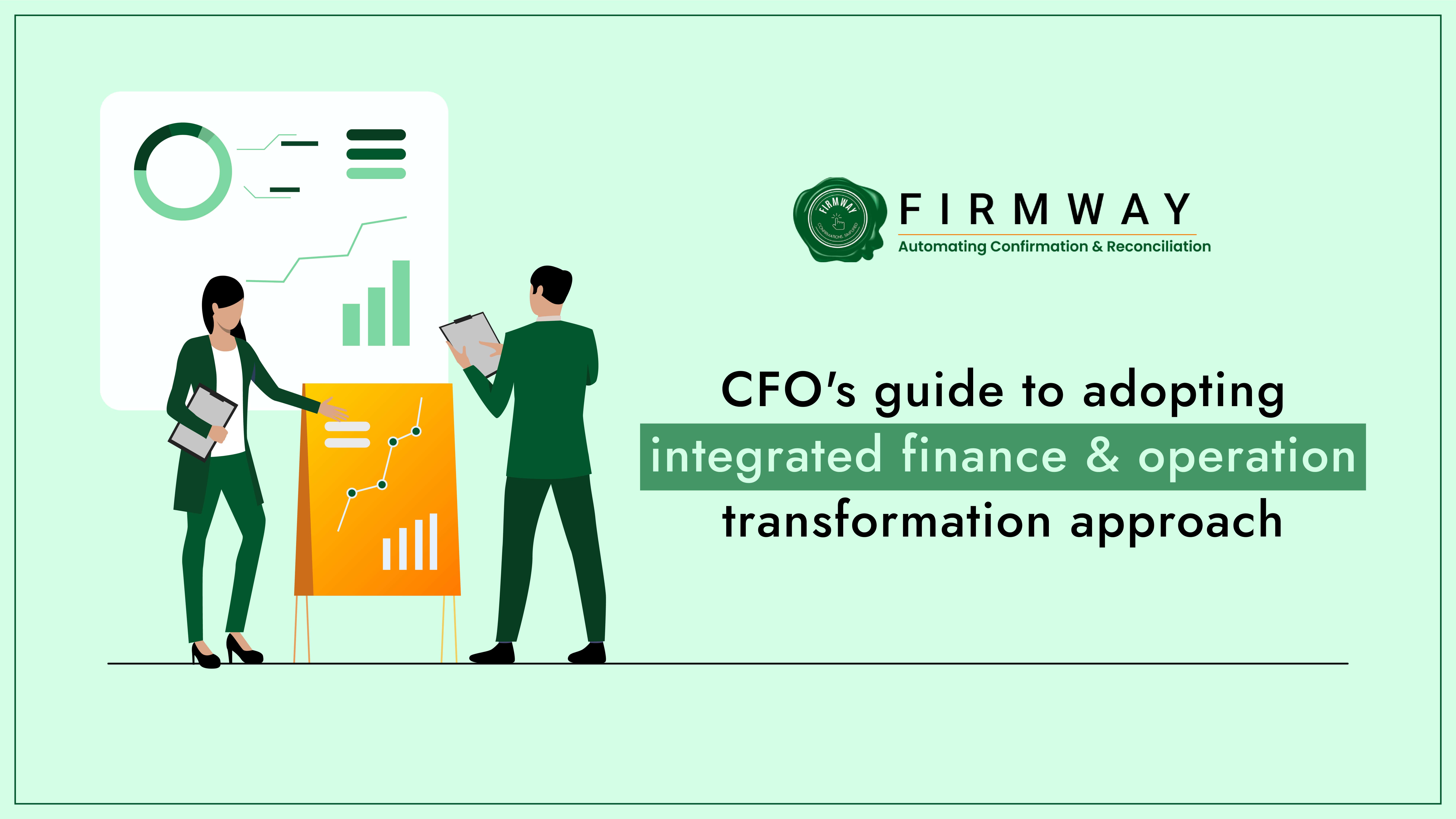
As the role of the CFO continues to evolve, consequently, finance leaders are increasingly taking on a more strategic role in their organizations. The shift is important considering the fact that CFOs are core to the finance of any organization. The strategic role includes not only managing the financial health of the company but also driving operational improvements, delivering business growth, and integrating finance ops. One of the key ways that CFOs can achieve these goals is through an integrated finance operations transformation approach.

Adopting Integrated Finance Operations Transformation Approach

An integrated finance operations transformation involves taking a holistic view of the finance function and identifying key areas for improvement. Additionally, the improvements can include streamlining processes, implementing new technologies, and automating manual tasks. By aligning finance operations with business goals and objectives, CFOs can drive significant value for their organizations. But how can an organization adopt an integrated finance operations transformation approach?

Finance Operations

Key Steps for Integrating Finance Operations

The following are some of the key steps that CFOs can take to implement an integrated finance operations transformation in their organization:

1. Identify Areas For Improvement:

The first step in any transformation is to assess the current state of operations. Before bringing transformation, we need to know the current status and lacunas. This includes identifying bottlenecks, inefficiencies, and areas where the finance function is not in tandem with business objectives.

2. Develop A Roadmap:

Once areas for improvement have been identified, CFOs should develop a roadmap for transformation. This step involves strategizing the future path. This should include clear goals, timelines, and metrics for measuring progress.

3. Implement New Technologies:

Adapting latest technologies is more of a necessity than a choice. One of the key ways to drive operational improvements is by implementing new technologies. Additionally, these technologies can include automated accounting systems, adopting cloud-based solutions, or implementing business intelligence tools.

4. Streamline Processes:

Another key aspect of an integrated finance operations transformation is streamlining the existing processes within the organization. This can include standardizing processes across the organization, eliminating unnecessary steps, and implementing process automation wherever appropriate.

5. Enhance Reporting And Analysis:

Top-level executives are often disassociated from ground-level operations. However, reporting is the way through which crucial information reaches top executives in any organization. Therefore, improving the quality and timeliness of financial reporting and analysis is critical for CFOs to drive business growth. This can involve implementing new reporting systems, adopting advanced analytics techniques, and enhancing data quality.

In a Nutshell: Integrating Finance Ops for Strategic Growth

By following these steps, CFOs can drive significant improvements in finance operations and position their organizations for success. An integrated finance operations transformation approach is key for CFOs who want to step out of their conventional roles and take a more strategic role in their organizations to deliver business growth.

MSME Vendor Identification

Unlock MSME Vendor Potential: Triumph for Chemical Giant

Ensuring Timely Payments and MSME Vendor Identification

The government has established explicit provisions to protect and reduce the credit risk of MSME vendors, including the crucial aspect of MSME Vendor Identification. To ensure that payments to MSMEs are not delayed beyond a specified period, the government mandates that companies disclose details when payments remain outstanding for over 45 days to MSME vendors. This provision necessitates accurate MSME Vendor Identification by companies.

What is an MSME?

Micro, Small and Medium Enterprises, also known as MSMEs, are defined under the Micro, Small and Medium Enterprise Development Act, 2006. The organizations that fulfill the following criteria are classified as MSME organizations:

Type of EnterpriseInvestment in plant & machinery or equipment should not be more thanTurnover should not be more than
Micro EnterpriseRs. 1 croreRs. 5 crores
Small EnterpriseRs. 10 croresRs. 50 crores
Medium EnterpriseRs. 50 croresRs. 250 crores

Thus, vendors who fulfill the above criteria will be classified as MSME vendors and consequently, the companies are required to ensure that their payments are completed within 45 days beyond which penal interest will be levied for micro and small companies. This necessitates them to verify which of their vendors are MSME vendors.

This becomes a tedious task especially when the company is dealing with thousands of vendors. Further, the MSME status keeps on changing each year. It is not necessary that a vendor who is an MSME vendor today will be an MSME vendor next year as well. Companies faced huge difficulties in verifying the MSME status of their vendors each year and automating this task was the need of the hour.

How A Ltd Automated MSME Confirmations?

A Ltd. is one of the giants in the chemical industry. Being one of the largest chemical companies, it dealt with 3 lakh vendors out of which 30,000 were active vendors. Its total annual purchases were Rs. 18,626.25 crores out of which it identified that only Rs. 110 crores were outstanding to the MSME vendors in the year end. Consequently, the huge gap in the figures raised concerns over the accuracy of the database. Clearly, automation was the need of the hour for getting MSME confirmations from such a huge number of vendors.

Earlier at A Ltd., the process for obtaining MSME confirmations was not systemised. A Ltd. obtained MSME confirmations 3 years before and the same confirmations were used each year to determine whether a particular vendor is an MSME or not. This led to inaccuracies in MSME identification and there were no updates as to whether an enterprise is still an MSME enterprise or not.

An automated solution was the need of the hour. That’s when they implemented Firmway’s MSME confirmation solution. Being a statutory compliance, it was important to ensure the accuracy of data. Due to non-accurate and untimely compliance led to penal interest @ 3 times of the bank rate notified by the RBI compounded with monthly rests. Consequently, this led to huge outflows in terms of penal interest which was a direct loss for the business.

How Firmway Helped A Ltd. Automate MSME Confirmations?

Firmway’s MSME confirmation tool allowed A Ltd. to automate its MSME confirmations. Following were the results that they witnessed after implementing Firmway’s MSME confirmation solution:

  • 30,000 MSME confirmations sent in a single click
  • 35% of the confirmations received in the first confirmation request itself
  • Overall, 80% response rate achieved. Earlier, it was just 15%-20%.
  • Nil error in detecting the MSME vendors.
  • 90% OCR verification success rate
  • 15,000 man-hours saved

Streamlining MSME Vendor Identification and Compliance

Earlier, they used to invest 100+ man-hours behind this confirmation exercise which eventually dropped to Zero after implementing the solution. Further, vendor education played an important role here. Firmway helped vendors understand the importance of MSME confirmations and why they were asked for their MSME status. Consequently, this led to a significant increase in their response rate.

Efficiently Managing MSME Vendor Data

Further, the solution auto-rejected old vendors from the system who claimed themselves as MSMEs earlier but were not MSMEs now. In fact, it identified that 40% of vendors were no more MSMEs. Further, the company had 3,000 new MSME vendors in the database and Firmway’s solution was able to identify MSME vendors with a 0% error rate.

Successful Implementation of Technology for MSME Compliance

A Ltd. was able to avoid penal interest rates as well as future ROC and CARO non-compliances. Identifying MSME vendors is posing significant difficulties for many such companies. However, by implementing technology, it is possible to automate the confirmations and ensure timely and accurate compliance. 

Section 43B

Section 43B Boost: Empower MSE Payments Now!

Introduction to Section 43B Amendment

The recent Union Budget 2023 stirred discussions, especially regarding the unprecedented inclusion of payments to MSE vendors. This falls within the ambit of Section 43B of the Income Tax Act 1961. Section 43B contains provisions pertaining to “Income from Business and Profession.” It lists all the expenses a given business entity can seek as deductions from their business income only in the financial year when they make the actual payment, disregarding the year when the entity incurred such expenses. Thus, it advocates deduction of spending on an actual payment basis.

Section 43B: An Overview

 The inclusion of payments to MSE vendors in the above regulatory framework strives to address the key issues MSEs counter as a result of prolonged payments. MSEs make up a fundamental segment of the Indian business ecosystem. According to quantitative analysis estimates by the Economic Times, delayed payments to MSMEs in India have resulted in approximately Rs 10.7 lakh crore being held up, which represents around 6% of India’s Gross Value Added (GVA) for the financial year 2020-21. 

MSE Inclusion in Section 43B

The addition of the MSE payments clause (h) in Section 43B can prove as a cornerstone amendment to streamline the payment receipt process for MSE ventures. Business organizations dealing with MSE suppliers, need to duly comprehend the applicability of the amended Section 43B on your payments. You also need to pay attention to the requirements of Section 15 of the Micro, Small, and Medium Enterprises Development Act (MSMED), 2006. The latest Finance Bill 2023 permits the deduction of expense paid to MSEs in line with Section 43B only when it abides by the time limit specified in Section 15 of the MSMED Act 2006. Thus, one can claim deduction on payment to MSE vendors if they are paid within 15 days in cases where there is no agreement. Or 45 days or as per the time period in a pre-defined written agreement, whichever comes first.

Guide to Section 43B Amendment for Businesses

Practical Insights and Illustrations

We provide practical insights on the treatment of payments to MSE vendors in various scenarios, assuming a predefined written agreement. Let’s explore specific situations to determine eligibility for deductions on MSE vendor payments based on the new clause addition.

Illustration 1:

A made a payment to a MSE after the time limit set by section 15 of the MSMED Act, 2006, but within the same financial year in which the expense was incurred. 

In this situation, A settled the payment after the specified time limit of Section 15 of MSMED Act, 2006. This activates the revised provisions of Section 43B. However, as the payment was made within the same financial year that the expense was accrued, deduction shall be permitted in that financial year as outlined by the regulations of the Income Tax Act, 1961.

Illustration 2:

Within the specified time limit under Section 15 of the MSME Act, 2006, B completes payment to an MSE and accrues the expense in the same financial year.

The provisions of section 43B of the Act would not apply to the payment that B made to the MSE. In the financial year in which the expense accrued, he will be permitted to take a deduction.

Illustration 3:

C dealt with an MSE where he had expenses that accrued in March 2024. However, he paid the vendor during the subsequent financial year in April 2024, within the deadline specified under Section 15 of the MSMED Act, 2006.

In this situation, C made the payment as per the time limit specified under section 15 of the MSMED Act, 2006. In the financial year 2023-2024, C will be able to calculate the payment in its tax on an accrual basis.

Illustration 4: 

D incurred an expense in the financial year 2023-2024 that was payable to an MSE. However, he settled it in the subsequent financial year, 2024-25. After the expiration of the time limit specified in Section 15 of the MSMED Act, 2006.

In this situation, because D made the payment beyond the time limit specified in Section 15 of the MSMED Act, 2006, and in the subsequent year, 2024-25, D will not be eligible to claim a deduction for that payment in the financial year 2023-2024 when the expenses initially accrued.

Illustration 5:

On March 16, 2024, E received an invoice from the MSE (Micro and Small Enterprise) for the supply of goods. E dealt with the MSE. The delivery person delivered the goods on the same day. On March 18, 2024, E communicated concerns about the quality of the supplied goods to the MSE vendor. Both parties resolved the dispute on April 30, 2024, and E made the payment on May 31, 2024.

Regulatory Compliance

It’s important to note that the disputing party raised the invoice dispute within 15 days of the delivery date. Therefore, the time limit defined in section 15 of the MSMED Act 2006 starts from the resolution of the dispute. E can claim a deduction for the payment in the financial year 2023-24. If E makes the payment within 45 days from the resolution of the dispute when the expenses accrued.

In summary, to ensure timely deductions and optimize your tax liability. It’s crucial to adhere to the regulatory requirements outlined in both the Income Tax Act 1961. The MSMED Act 2006. Failure to confirm your vendor’s MSME registration status could result in disallowed payment deductions and late payment penalties.

Firmway’s MSME Status Confirmation Tool

Collaborate with Firmway to gain an avante-garde solution in the form of an MSME status confirmation software. By using Firmway’s MSME Status confirmation tool, you can seek MSME status from your vendors and verify the same through MSME government databases and OCR technology. It simplifies the process of getting your vendor’s MSME status validation by leaps and bounds. 

Reach out to know more about this software.

Firmway is a SaaS based startup that has successfully automated Balance Confirmation and Ledger Reconciliation, for well-known companies such as Sodexo, Asian Paints, IPCA, Bluestar, Gati Logistics, and 500 more.