Automate TDS Reconciliation with Firmway: Benefits & Challenges

TDS Reconciliation Made Easy: The Benefits Of Automated Solutions

Why companies need to Automate TDS Reconciliation?

Customers deduct TDS on every sale of goods and services above a certain limit, requiring TDS reconciliation. Companies need to reconcile TDS periodically by extracting transaction data from Accounting Software as well as 26AS form from the government portal to ensure that the client has given proper credit and avoid penalties and audit risk. The TDS and TCS that are eligible for credit are reflected in the statement while reconciling with the ledgers.

The deductee pays the amount stated in the statement as advance tax, making it eligible for credit. Hence, matching the amount with the TDS/TCS in the receivable ledgers of the deductee is of utmost importance. If you are doing it manually, the process is very vast, but Firmway can help you automate TDS reconciliation in 60 seconds.

TDS Reconciliation

Unlocking Efficiency: The Role of Automated TDS Reconciliation

The majority of organizations today manually perform this crucial process. A survey revealed that Tax managers dedicate, on average, at least 8 hours a week to manual data tasks, with 25 percent reporting spending over 20 hours a week on such tasks.

In another survey of over 280 companies, respondents reported that they could eliminate a large part of inefficiencies by using automated tools, with 62 percent indicating this. Just like the other financial functions, TDS reconciliation is faced with a similar fate. Accurate reconciliation of TDS credit reduces the tax burden and ensures no loss of TDS credit. However, due to manual intervention, faces the following challenges:

Challenges spelled out 

  • The possibility of manual errors in inputting amounts while filing returns can result in a mismatch.
  • For a deductee with a large number of customers, matching amounts is a herculean task.
  • The frequent updates to 26 AS make it time-consuming to reconcile and track on Excel worksheets.
  • Adopting manual work involves different people and their different ways of working. This lacks standardization and discipline. Communication usually happens over email and is easy to falsify or spread misinformation.
  • Proactive tracking of discussions with the tax deductor or collector for corrections due to identified mismatches. Teams in finance need to manually communicate over endless emails and calls.
  • Version control of Excel sheets and other documentation can cause issues in many instances.
  • While working in a manual model, you might keep the reports in disparate places.
  • The booking of TDS in the books of the deductor and deductee can be for different periods. Time differences spill over from one quarter to another quarter in the form of 26AS, causing further discrepancies.

Automating this process will enhance accuracy for 26 AS and significantly reduce time spent processing low-value-adding activities. It also enables us to manage TDS and TCS credits as per Form 26AS and books of accounts and almost nullify leakages.

What are the benefits of automating the reconciliation process? 

Running a tax department equates to having a plethora of responsibilities, especially concerning compliance and regulations like TDS. However, using reconciliation automation tools helps expedite the reconciliation process and closure while also improving compliance, enhancing accuracy, and promoting transparency.

  • Firmway’s 26 AS Reconciliation Software is also one such piece of software that makes the reconciliation process seamless for the organization.
  • Maps the TAN number with the PAN number for reconciling
  • It can reconcile large volumes in 60 seconds.
  • With the flexibility, it offers in quarterly, half-yearly, and annual reconciliations, it highlights mismatches and classifies entries into different buckets for ease of operations.
  • Efficiently manages communication with parties and generates actionable reports as and when required

Automation of the reconciliation process is truly the need of the hour for any business. With manual processes, it’s difficult to scale in response to the reconciliation when there is an increase in transactions. However, automation of the process makes the entire process effortless.
GSTR-3B

GSTR-3B Return Filing: Expert Tips And Guidelines You Need To Know

GSTR-3B: Insights

The government has published the GSTR-3B format for filing #GST returns for the months July’17 and Aug’17.

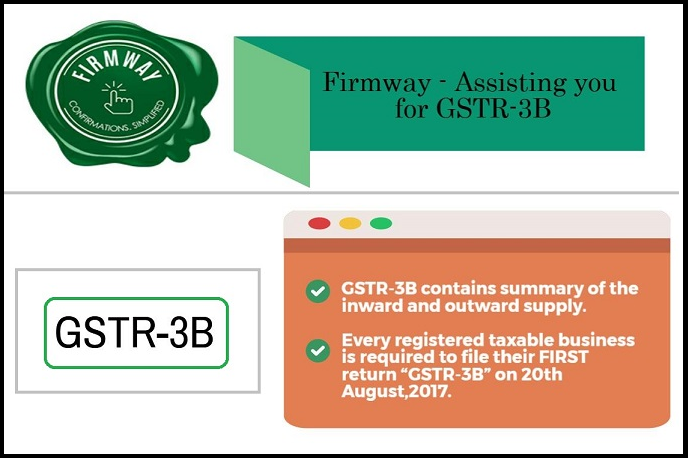
Furthermore, to ensure a smooth rollout of GST and address industry concerns about return filing, authorities decided that businesses would pay taxes based on a simplified return (Form GSTR-3B) during the first two months of GST implementation. Additionally, this form includes a summary of both outward and inward supplies, which businesses must submit before the 20th of the following month.

Moreover, the GSTR-3B form simplifies the filing process. Registered persons must submit consolidated details in a simplified manner as notified.

Introduction to GSTR-3B

The monthly GST return form effectively simplifies the GST return filing process by consolidating taxable values and tax amounts for outward and inward supplies, input tax credit, and other essential GST transactions. Furthermore, it provides a comprehensive overview of financial transactions within a specified period, ensuring accuracy and compliance with GST regulations. Additionally, this streamlined approach facilitates easier reconciliation and auditing, thereby enhancing overall transparency and accountability in tax reporting

Importance of Timely Filing

Timely filing of GST returns is crucial to avoid penalties and interest charges. Moreover, compliance with filing deadlines ensures financial discipline and prevents additional costs. Furthermore, adhering to these timelines helps maintain smooth business operations and enhances regulatory compliance.

Details to be furnished in Form GSTR-3B is as follows:

1. Outward and Inward Supplies

The tax filing form mandates that taxpayers report consolidated taxable values and tax amounts for both outward and inward supplies, including supplies liable under the Reverse Charge Mechanism (RCM). Additionally, it underscores the necessity of accurate reporting to maintain compliance with tax regulations. Furthermore, this reporting requirement ensures transparency in financial transactions and aids in preventing tax evasion.

2. Inter-State Supplies

Details of inter-state supplies made to unregistered persons, composition taxable persons, and those holding Unique Identification Numbers (UIN) must be reported in the GST return filing form applicable to such transactions.

3. Input Tax Credit

Eligible input tax credit can be claimed based on the transactions reported in GSTR-3B, subject to compliance with GST rules and conditions.

4. Exempt, Nil-rated, and Non-GST Inward Supplies

Accurate reporting of exempt, nil-rated, and non-GST inward supplies in GSTR-3B ensures compliance with GST regulations.

5. Payment of Tax and GST TDS/TCS Credit

The GST return form also requires taxpayers to provide details regarding the payment of tax and GST TDS/TCS credits, ensuring comprehensive reporting of financial transactions under GST.

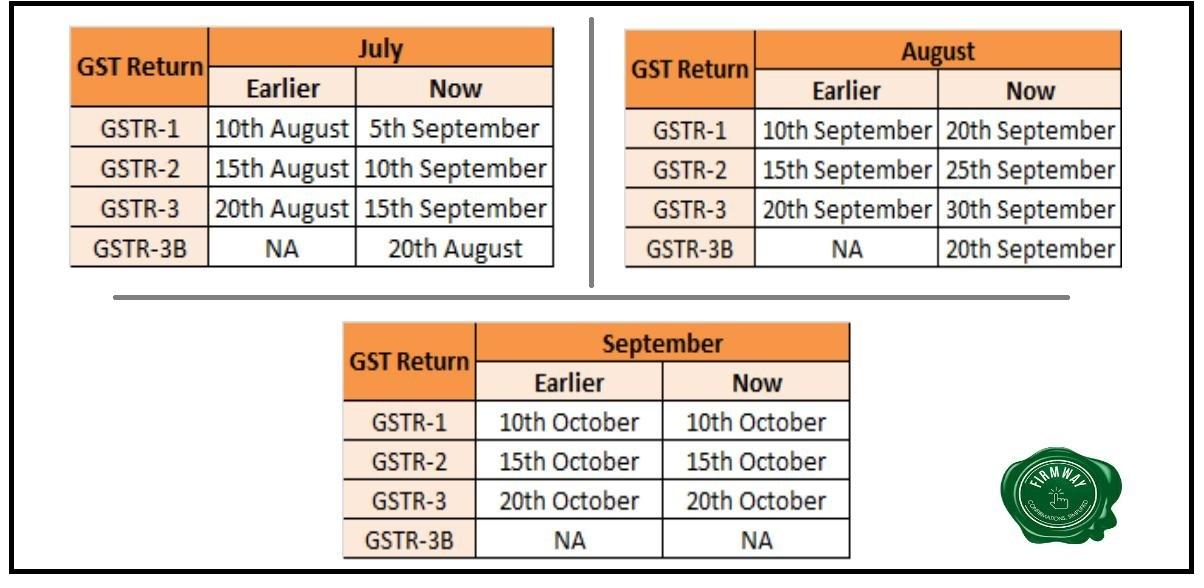
GST returns will have to be filed for the months of July and August 2017 as per the timeline given below:

GSTR-3B

Firmway’s Role in Assisting with GSTR-3B

Firmway assists businesses in aligning with vendors and customers, thereby ensuring timely filing of their first GST return within a week. As a result, this prevents unintentional interest costs, helping businesses maintain financial efficiency and compliance

Conclusion

The simplified GST compliance process for businesses not only facilitates but also streamlines the return filing process. Moreover, timely and accurate filing is essential to avoid penalties and maintain compliance with GST regulations.

[/vc_column_text][/vc_column][/vc_row]

GST

GST Registration: What You Need to Know to Drive Growth

Would only registration lay the perfect platform in Cracking Code to GST Success?

While ruling out the possibilities for any further delay in implementation of GST, Finance Minister Mr. Arun Jaitely had expressed, “Of the total 8.09 million existing tax payers, 81.1% have already registered.”

But would only registration itself  be the Cracking Code to GST?

The Importance of Financial Discipline for GST Compliance

Financial Discipline is the primary intention behind drafting the entire law from the grassroots level.
Financial Discipline also helps you find the revenue leakages and manage your business.
It also helps you allocate resources and expenses, which results in profitable outcome.

The Role of Accurate Input Tax Credit in GST

How can we expect a boy, who is not well-dressed at school entry, to stay disciplined all day? Similarly, taxpayers also need financial discipline by cleaning their books and ensuring accurate input tax credit carry-forward. Consequently, less carry-forward leads to fund blockage; on the other hand, excess invites scrutiny and interest costs.

Ensuring Precise GST Tax Credit Carry-Forward with Invoice-Level Matching

So, how to ensure precise tax credit carry-forward with invoice-level matching?

GST

Common Reasons for inaccurate input tax credit:

  1. The deductions made for quality issues, delay in delivery, damages, etc.
  2. Rejected material not sent back.
  3. In the case of works contract: approval of completed work is pending, escalation claims, scope change claims, etc.
  4. Service tax credit on advance payment.
  5. Invoice not received for Goods and Services, and so forth.

Strategies to Ensure Accurate Input Credit for GST

A. Ask your suppliers, service providers, and customers to share pending invoices, debit/credit notes, and unreported deductions or rejections.

OR

B. Get transaction and balance confirmation from suppliers, service providers, and also customers.

Leveraging Technology for Efficient GST Reconciliation

Strict deadlines for Excise & VAT returns (ending June 30, 2017) significantly affect the feasibility of this activity. Consequently, this is where FIRMWAY’s digital platform comes in, effectively expediting confirmations.
Firmway has impressively achieved 80% reconciliations (in value) within a week, and fortunately, this was accomplished with minimal accounts team involvement

 firmway.in to know more about Firmway.